
What Is No-Code Development? How It Works & Who It’s For

Building software used to mean one thing: you needed developers, long timelines, and heavy budgets. That assumption is now broken. Modern visual platforms allow people to create real applications without touching traditional programming languages. This shift is changing how products are launched, how internal tools are built, and who gets to participate in digital creation.
At its core, No-Code Development removes technical barriers and replaces them with visual logic, prebuilt components, and automation. The result is faster execution, lower costs, and far more experimentation across teams.
This guide breaks down how it works, what it can (and can’t) do, and who benefits most from adopting it.
What Is No-Code Development?
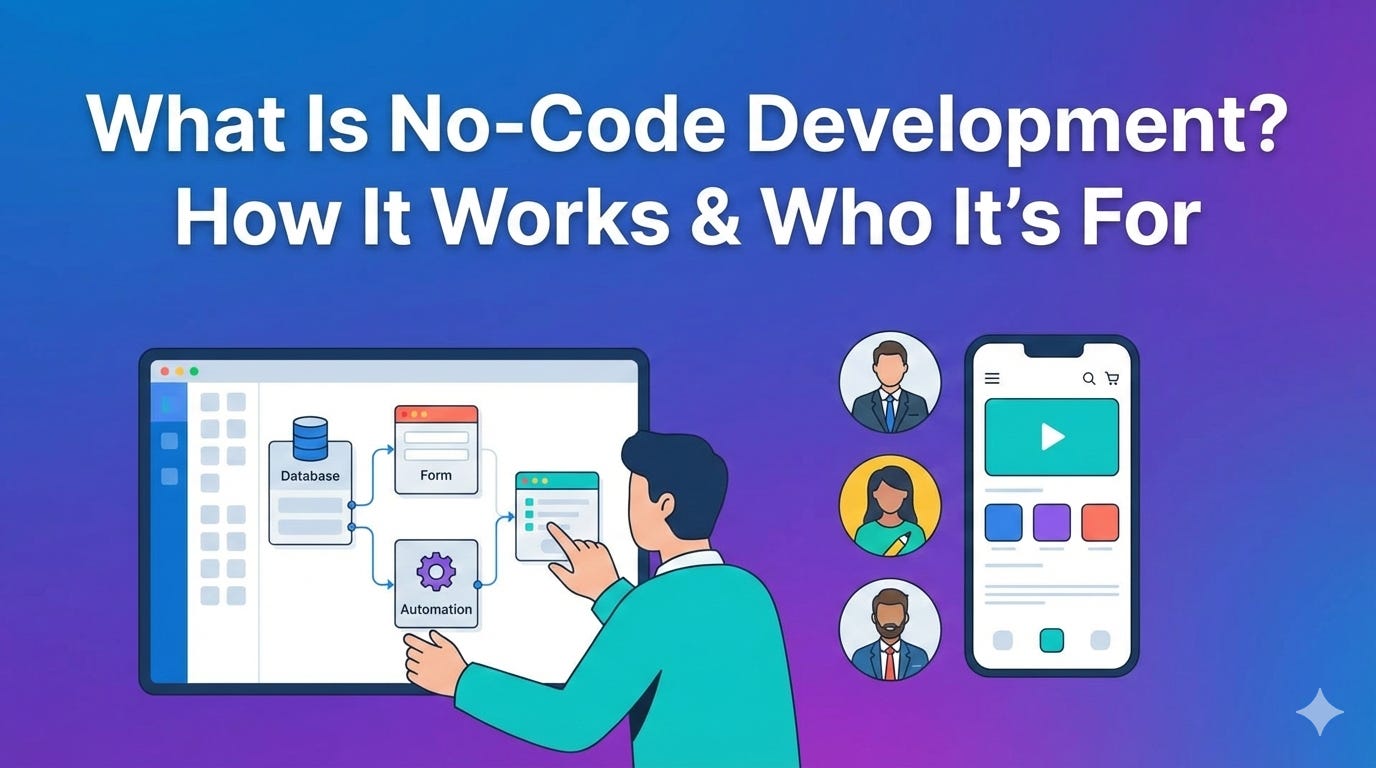
No-Code Development is an approach to building software applications using visual interfaces instead of traditional programming languages. Rather than writing code, users assemble applications by dragging and dropping components, defining workflows, and configuring logic through intuitive dashboards.
The goal is simple: enable non-technical users to build functional, scalable applications without depending entirely on engineering teams. These platforms abstract complexity while still allowing users to create apps that connect to databases, APIs, and third-party services.
This isn’t about cutting corners. It’s about shifting effort from writing syntax to solving real business problems.
How No-Code Platforms Actually Work
Behind the scenes, visual builders generate structured logic that replaces handwritten code. Users interact with a graphical layer, while the platform translates actions into executable processes.
Most platforms follow a similar flow:
Visual UI builders define screens and layouts
Logic builders handle conditions, triggers, and workflows
Data layers manage records, relationships, and storage
Integrations connect external services like CRMs or payment gateways
Everything runs on managed infrastructure, meaning hosting, scaling, and security are handled by the platform itself.
Key Components That Power No-Code Tools
Every platform is built on a few core elements that make creation possible without technical expertise:
Visual Interface Builders These allow users to design screens, forms, and dashboards using prebuilt elements.
Workflow Automation Rules-based logic lets users define what happens when actions occur—submissions, approvals, notifications, or updates.
Data Management Tables, relationships, and permissions are handled through structured visual models instead of SQL or scripts.
Integrations and APIs Connections to tools like Stripe, Google Sheets, or Slack extend functionality without custom development.
Types of Applications You Can Build Without Coding
No-code tools are not limited to prototypes. Many production-grade applications are built this way, including:
Internal dashboards and admin panels
CRM and lead management systems
Workflow automation tools
Customer portals and booking platforms
MVPs for startups and new product ideas
Approval systems and operational tools
The focus is on speed, usability, and solving narrow but valuable problems.
Who Should Use No-Code Platforms
These platforms are designed for people who understand the problem better than the syntax.
Founders and Entrepreneurs Launch products fast, test ideas, and validate markets without hiring full engineering teams.
Operations and Business Teams Build internal tools tailored to exact workflows instead of forcing generic SaaS products.
Marketing and Growth Teams Create landing pages, lead systems, and campaign dashboards without development bottlenecks.
Product Managers Prototype flows, test logic, and communicate requirements clearly before full-scale builds.
Benefits of Going No-Code
The appeal goes far beyond ease of use.
Speed to Market Applications that once took months can now be built in days or weeks.
Lower Costs Reduced dependency on large engineering teams cuts development and maintenance expenses.
Empowered Teams Business users gain autonomy, freeing developers to focus on complex systems.
Rapid Iteration Changes can be made instantly without long deployment cycles.
Limitations You Should Know Before Adopting
Despite the advantages, no-code is not a universal solution.
Customization Limits Highly complex or unique logic may exceed platform capabilities.
Performance Constraints Some platforms struggle at massive scale or under heavy real-time loads.
Vendor Lock-In Applications are tied to the platform’s ecosystem and pricing model.
Security and Compliance Enterprise-grade compliance may require additional review depending on use case.
Understanding these limits is critical before committing long-term.
No-Code vs Low-Code: What’s the Real Difference?
While both approaches aim to speed up development, they serve different audiences.
No-code platforms are built for non-technical users and eliminate coding entirely. Low-code tools still require developers but reduce the amount of manual coding needed.
In practice:
No-code prioritizes simplicity and accessibility
Low-code prioritizes flexibility and extensibility
The choice depends on who is building and how complex the final product needs to be.
When No-Code Is the Right Strategic Choice
This approach works best when:
Speed matters more than perfect customization
The application supports internal processes
Budgets or timelines are tight
Requirements are likely to change frequently
It is especially effective for experimentation, process optimization, and early-stage products.
Future of No-Code in Product and Business Teams
Visual development isn’t just a passing phase it represents a fundamental shift in how applications are built. As low-code platforms continue to evolve, they’re becoming more robust, scalable, and deeply integrated with enterprise systems, making the Benefits of Low-Code App Development increasingly clear for organizations seeking faster delivery, flexibility, and long-term growth.
No-Code Development will continue to blur the line between technical and non-technical roles. The future belongs to teams that can think clearly, build quickly, and adapt without friction.
The companies that win won’t be the ones that write the most code—but the ones that solve the right problems faster.